 Energy Heritage
Start with the rooms, not the old boiler rating
Ask for an assessment of heat loss and the heating required in each room. Energy Saving Trust explains that heat pumps can be used in older properties, but appropriate design is important. The output printed on an existing boiler is not, by itself, the brief for its replacement.
Give the assessor your fuel records, usual heating schedule and notes about rooms that are difficult to warm. Explain any planned insulation or window work. A proposed system should state which version of the house it assumes: the building as it stands today or the building after those improvements. Mixing the two can make a comparison confusing.
Ask about radiators and hot water
Air-to-water heat pumps supply a water-based heating system. Energy Saving Trust notes that radiators may need upgrading and that space for hot-water storage may be needed. Ask which existing emitters can remain, which require changes and what conditions the design assumes. Do not accept a vague promise that every radiator will be fine without an explanation.
Discuss baths, showers and the household’s hot-water routine. Request the proposed cylinder size, location and associated work, where a cylinder is needed. A drawing showing the equipment and service access is more useful than discovering on installation day that a cupboard has another essential use.
Consider the outdoor location early
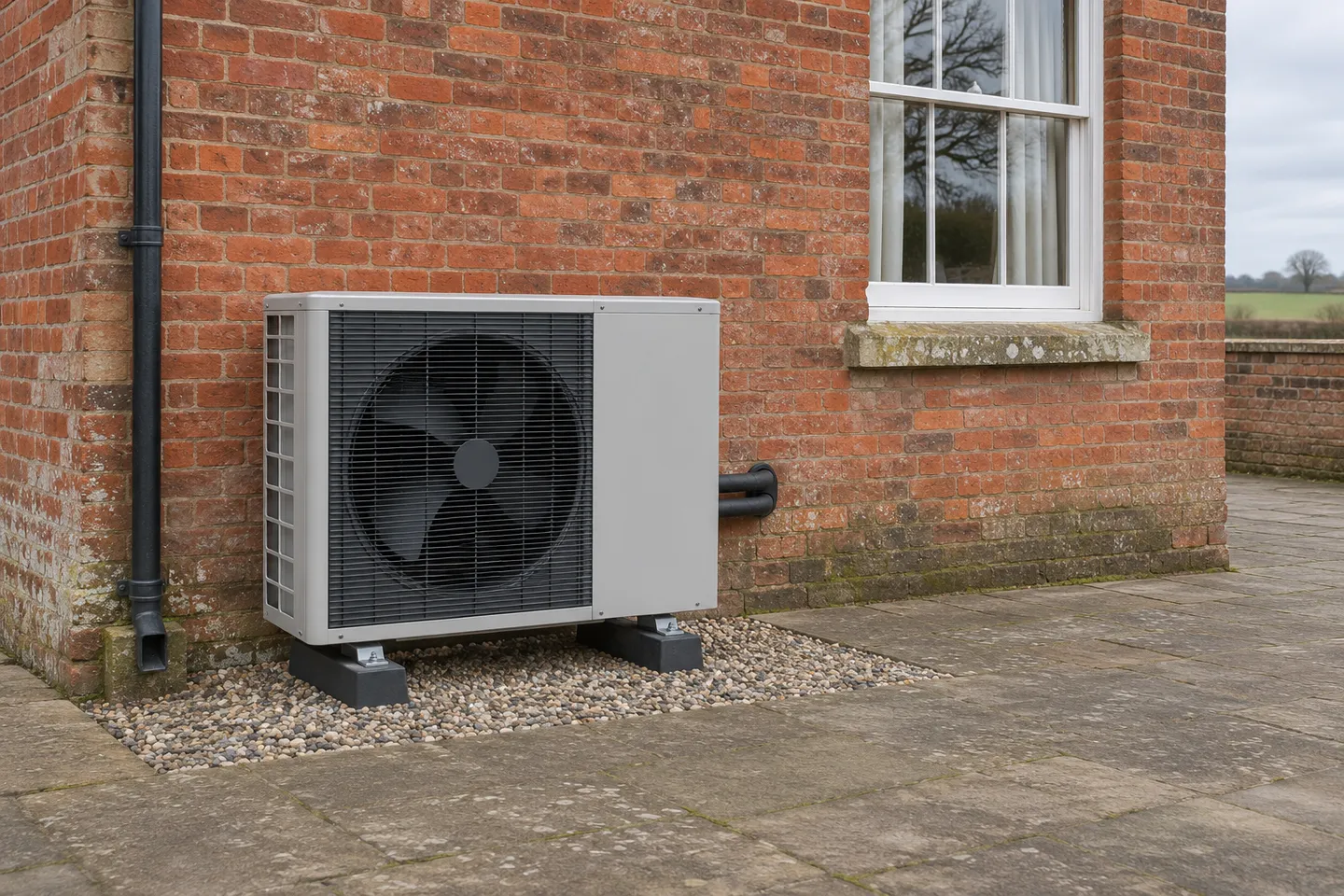
The outdoor unit needs a suitable position with the clearances, airflow and access required by the manufacturer. Ask the installer to explain noise, condensate drainage and maintenance access at the proposed location. Include nearby windows, paths and neighbours in the conversation. A neat-looking position is not automatically a technically suitable one.
For an older property, also consider the effect of pipe routes and equipment on the building. Ask the installer and relevant authority to confirm any planning or heritage requirements before work proceeds. Rules and circumstances vary; a generic statement that heat pumps never need permission is not a sufficient assessment of your site.
Read a running-cost forecast as a set of assumptions
Consider a simplified example using 12,000 kWh of useful heat a year. If a heat pump delivered an assumed seasonal performance factor of 3, it would need 4,000 kWh of electricity for that heat. At an illustrative flat rate of 25p per kWh, the energy cost would be £1,000. These are invented inputs for explaining the arithmetic, not a forecast for an older house.
For comparison, supplying that heat with gas at an assumed seasonal boiler efficiency of 85% would require about 14,118 kWh. At an illustrative 6p per kWh, that is about £847. Changing prices or performance changes the result. Both figures exclude standing charges, servicing and installation. A real quotation should specify its system boundaries, including hot water, auxiliary electricity and any backup heating.
Plan the handover as carefully as the installation
Ask how the system is intended to run and what support is included after commissioning. Request a demonstration of the controls, the normal operating schedule and the process for reporting a comfort problem. Keep the design, commissioning records and manufacturer’s maintenance requirements together.
Agree how performance will be assessed through a heating season. A single warm day does not establish winter comfort, and a short cold spell is not an annual efficiency measurement. Place the decision in your wider improvement plan, with clear expectations for cost, comfort and disruption rather than a promise based on the house’s age alone.
Sources & further reading
Checked 16 November 2026. General guidance for UK households; building advice and permissions vary by property and location.